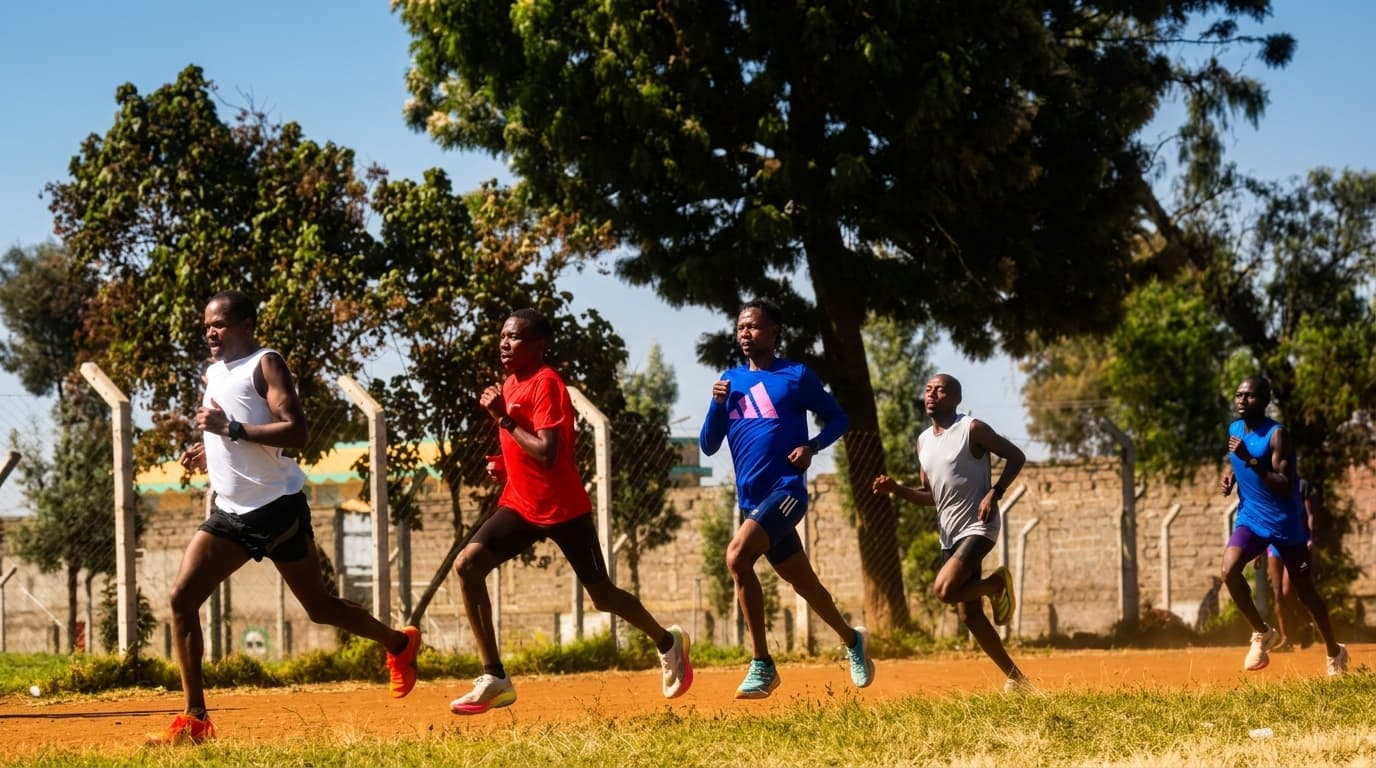
Kenyan runners train primarily by effort rather than GPS pace, building aerobic volume at altitude before adding race-specific intensity in the final weeks of a training block.
Outside Kenya, runners often train by pace. Their plan has 4:30/km for tempo, so they hit 4:30 or feel like they failed. Kenyan training doesn't work this way. Pace is a downstream result, not an input, and understanding why changes how you think about every run on your schedule.
At KenyanRunning, our coaches are professional runners who still train and race at altitude in Kenya. What follows isn't secondhand analysis. It's the methodology they use on themselves and apply to the recreational athletes they coach.
Effort before pace
Kenyan runners structure sessions around perceived effort and physiological purpose, not GPS targets. An easy run is genuinely easy: conversational, unhurried, often slower than visiting runners expect. A hard session is specific: fartlek with defined recovery, hill repeats at a controlled intensity, or a long tempo where the effort builds across the session rather than locking into a single pace.
There's a practical reason for this. At 2,100+ meters (roughly 7,000 feet), pace is unreliable. The same effort that produces 3:30/km at sea level might produce 3:50/km in Nyahururu or Iten. Runners who grow up training at altitude learn to calibrate by feel because the numbers on a watch don't transfer across elevations. That skill (reading your own effort accurately) is one of the most transferable things a Kenyan coach brings to recreational athletes.
Periodization: build the base, sharpen late
Kenyan distance training follows a periodization structure that prioritizes aerobic volume early and intensity late. A typical buildup for a goal race spans 12 to 16 weeks and moves through distinct phases:
Base phase (4–6 weeks). High-volume easy running, often with one longer fartlek session per week. The goal is aerobic capacity and structural resilience: tendons, ligaments, and muscular endurance that can absorb harder training later. Weekly mileage tends to run higher than a typical Western recreational plan prescribes for the same race distance.
Transition phase (3–4 weeks). Tempo efforts and longer intervals appear. The fartlek sessions become more structured. Easy days stay easy, but the hard days get harder. This is where lactate threshold and economy work begins in earnest.
Sharpening phase (2–3 weeks). Race-specific work dominates: goal-pace intervals, time trials, and sessions that rehearse the demands of the target event. Volume drops. Recovery between hard sessions increases. The base built in the first phase is what makes this intensity sustainable without injury.
Taper (1–2 weeks). Volume drops sharply while intensity stays. A few short, sharp efforts keep the neuromuscular system primed. Easy running fills the rest. The full week-by-week structure our coaches use is in the three-week marathon taper plan, and the final seven days are covered in the race-week prep guide.
This structure isn't unique to Kenya. Lydiard, Canova, and Renato have all articulated versions of it. What's distinctive about the Kenyan application is the commitment to the easy days being truly easy and the volume being genuinely high relative to the runner's capacity, even at the recreational level. The ratio of easy to hard running in a typical Kenyan-coached week is roughly 80/20, and the running done in that 80% is slower than a self-coached runner would typically tolerate.
Want to see how this applies to your own marathon build?
Use the free marathon readiness tool for a quick signal, or take the quiz if you already want help choosing the right coaching tier.
Mileage: more than you think, slower than you'd expect
Kenyan runners run a lot. Most of it is slow. A professional runner in a Kenyan training camp might run 160–200 km per week, with only two or three quality sessions. Everything else is recovery pace.
For recreational runners, the principle scales down but the ratio holds. When our coaches build a plan for a 40 km/week runner, they still protect the easy days, push the long run, and concentrate intensity into two sessions instead of scattering it across every run.
Fartlek: the quality session most runners misunderstand
Fartlek is the most common quality session in Kenyan training, and it is widely misunderstood by runners who encounter it in Western plans. In Swedish it means "speed play," and the original version is genuinely playful: effort picks up on a hill, eases off when the group decides, surges again without a prescribed distance or target. Kenyan coaches use a more structured version, but the principle matters.
A typical fartlek session in a Kenyan group might be 60 minutes of running with 10×1-minute surges on effort, alternated with 2-minute easy floats. Or 30-minute continuous effort broken into sections where the pace gradually increases over the final third. The key is that the "recovery" between efforts is still running, not standing still, not walking. This trains the ability to recover while moving, which is exactly what a marathon demands.
For recreational runners, fartlek has a practical advantage over track intervals: it requires no precise measurement, works on any terrain, and naturally adjusts to the runner's fitness on a given day. When our coaches prescribe fartlek, the instruction is deliberately effort-based rather than pace-based, which makes it useful regardless of where the athlete trains.
Group training and what it actually provides
Kenyan professional runners rarely train alone. The group does several things that individual training cannot replicate: it sets the pace honestly (you cannot negotiate with a group), it distributes the mental load of a long hard session, and it creates an accountability structure that coaches do not need to manufacture.
For recreational runners working with an online coach, the group dynamic does not exist in the same form, but the logic behind it does. A coach serves a similar function: an external reference point that keeps the easy days honest and the hard days real. The runner who knows their coach will read the session notes tends to execute more accurately than the runner who trains entirely by self-reported effort.
This is one reason why coaching at any tier matters more than the specific plan. The plan is a template. The coach is the accountability structure that makes the template work.
Recovery as a deliberate training input
In Kenyan training camp environments, recovery is treated the same way as the training sessions: structured, protected, and non-negotiable. Athletes in camps sleep 8–10 hours, eat simply and consistently, and spend the hours between sessions resting rather than accumulating stress from commutes and screen time.
Recreational runners rarely have access to that environment, but the principle scales down. Recovery is not the absence of training. It is the mechanism by which training adaptations actually happen. An athlete who runs hard and sleeps 5 hours is getting a fraction of the benefit of an athlete who runs hard and sleeps 8 hours. The adaptation happens during recovery, not during the session itself.
This is why KenyanRunning coaches ask about sleep and work schedule during the intake process. The training plan is built around what recovery the athlete can actually access. More training is only better when the recovery supports it, and a good coach calibrates the load to the life rather than building the life around an ideal training block.
Want it from a Kenyan runner?
Get the Kenyan Running Method book, free
Eleven chapters by Martin Karoki Muriuki, a Kenyan pro with a 14:13 5K: the sessions, hills, rest, shoes and race day. Enter your email and we send a link to read it online and a PDF to keep.
Or read the first three chapters first.
Why this matters for you
If you've been running all your easy days at "moderate" effort, or chasing pace targets that leave you too tired to execute your hard sessions well, this is what our coaches will fix first. Slow down your easy days. Build your weekly volume before adding speed. Periodize toward your race; don't just repeat the same week for three months.
That's what a KenyanRunning coach will build for you: the same structure they use in their own training, adapted to your schedule, your fitness, and your goal race. The application looks different depending on the target: first-marathon coaching emphasizes disciplined progression, Boston Qualifier coaching emphasizes stacking patient weeks, and sub-3 marathon coaching emphasizes the tight execution discipline serious marathon racing demands. If you want the shorter decision version, start with what makes Kenyan running training different. If you want to see how it becomes a real build, here's what the first month looks like.
Ready to train the Kenyan way?
Get matched with a professional Kenyan coach who will build your training plan based on these exact principles. No more guessing at paces.
Start coaching: plans from $79/mo →What to read next
Follow the thread that matches where you are right now: understanding the method, deciding whether coaching is worth it, or choosing the next practical step.
Martin's 11-chapter guide to everything on this page: his real week, the sessions, hills, rest and race day. Free to read, PDF included.
Related next stepWhat is the Kenyan running method?The method behind the viral ebooks, explained by coaches who train that way, and what you can't get from a PDF.
Related next stepWhat makes Kenyan training different?Read the shorter, more decision-focused version if you want the practical takeaway without the full breakdown.
Related next stepCheck your marathon readinessUse the free tool to see whether your current mileage and long run support the goal you are chasing.
Related next stepSee marathon coachingSee how KenyanRunning applies these same principles to a real marathon build.
Related next stepExplore the Kenyan Running Race IndexSee how major marathons rank by course difficulty and elite field depth.